
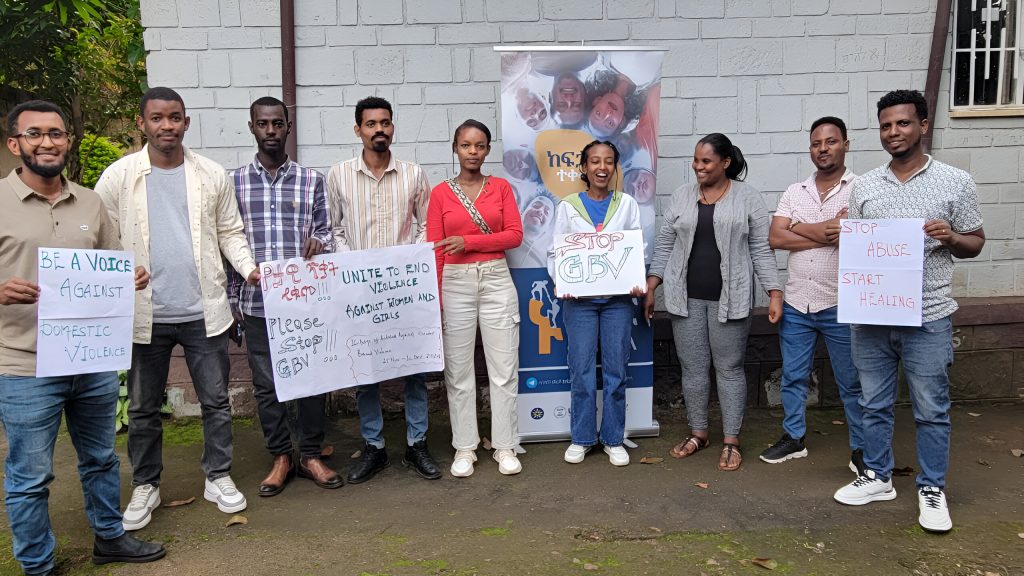
School-Related Gender-Based Violence (SRGBV) is defined as acts or threats of Sexual, Physical or Psychological Violence occurring in and around schools, perpetrated as a result of gender norms and stereotypes, and enforced by unequal power dynamics. It also refers to the differences between girls’ and boys’ experiences of and vulnerabilities to violence. SRGBV includes explicit threats or acts of physical violence, bullying, verbal or sexual harassment, non-consensual touching, sexual coercion and assault, and rape. Corporal punishment and discipline in schools often manifest in gendered and discriminatory ways. In addition, boys are brought up in environments that promote harmful gender norms, roles and stereotypes, justifying aggression and violence as desirable masculine behaviors. Other implicit acts of SRGBV stem from everyday school practices that reinforce stereotyping and gender inequality, and encourage violent or unsafe environments. In Ethiopia SRGBV problem continues to deepen in recent years. It is one such problem that is creating tension not just for schools or parents but for students, particularly female students. School violence and bullying (for this text we understand bullying as a significant, pervasive form of school violence) is the condition when a student or group of students gets engaged in any type of harmful activity. Such types of activities are usually targeted to female students, and therefore, harmful and very serious for the schools, teachers, parents and nation as well.
Because of its deleterious effect on both victims’ and bullies’ current and future functioning, IA has focused on this issue as the first step to help national and local regional education agencies and schools create safe places for female students to learn. YCDF understands that school violence can be prevented by teachers, parents, and students as well. YCDF is unique in teaming up with Initiative Africa (IA), using a grant provided by the Swedish Embassy, to collaborate towards the reduction or even the outright eradication of school violence in Ethiopia. With collaboration between the IA, local civil societies, schools, public universities, and local authorities, YCDF has over the past two years made significant progress in designing a comprehensive tool for measuring school violence prevalence, concluding with the design of the Violence Measurement Index in 2017. The tool provides genuine measures about school violence and safety concerns and involves teachers, administrators, parents, and students’ representatives. It is designed to help schools understand and effectively prevent school violence, and can be administered annually or biennially to monitor the factors that increase or decrease the likelihood of school violence, and what prevention strategies work.
In earlier times, schools were considered as a sacred place meant for imparting knowledge to the students. However today, scenario has changed to a very large extent. The modern schools of present are quite different to schools of the past in several ways. These new generation schools are not safe from the school violence point of view. Many surveys have been conducted in order to find out the actual rate of school violence. YCDF, within the context of the Ethiopian Initiative for Girls Science Teaching and Achievement (EIGSTA) project funded by the Australian Government has also conducted one such survey in Addis Ababa with 15 secondary schools to provide a perspective. The survey revealed that FACTS ABOUT SCHOOL VIOLENCE
abuses) happen daily on 3 out of 4 girls
happened on a girl by at least one of her teacher
accountability, poverty, tradition and culture that suppress girls were underlined as the main causes
of violence against girls
The survey alludes that the problem of young people and violence is systemic. Indeed, we are in denial if we think the problem simple. We all contribute to it by standing by and letting it happen. If the parents, teachers along with t other students work together then problems like school violence can be removed. If parents provide good atmosphere in the house then it becomes easier for the students to maintain the regularity in the studies and therefore they can perform better. A cool, hygienic and healthy environment in the schools and in the house is essential for the future of children and nation as well. Parents should keep an eye on their children so as to check whether they are doing or engaged in any type of violent behavior. They should closely follow the regular activities of their children like whether they are easily engaged in aggressive actions or feel cool when displaying violent action. These behaviors may show the first signs of children heading towards accepting violence as a normal condition.
School administration should also take care of certain things for the prevention of school violence including
focusing on:
Counseling: - If school authorities and teachers want to prevent incidences like school violence then they should appoint a good counselor in the school. Counselors can really help students by providing good and right direction related to career and any type of personal issues.
Security: - If proper security measures are taken by schools then school violence can be prevented with ease. For this schools should appoint a good guard in the campus and must find ways for searching metal bars that can be used to harm a person, knives etc. in the school premises etc. Although the above are some of the basic approaches that schools, parents and students need to work on, if there's one thing school safety experts agree on, it's this:
There is no perfect solution to preventing school violence. The good news is that schools in Ethiopia are at least aware of the problems and want to learn and try new means at preventing violence.
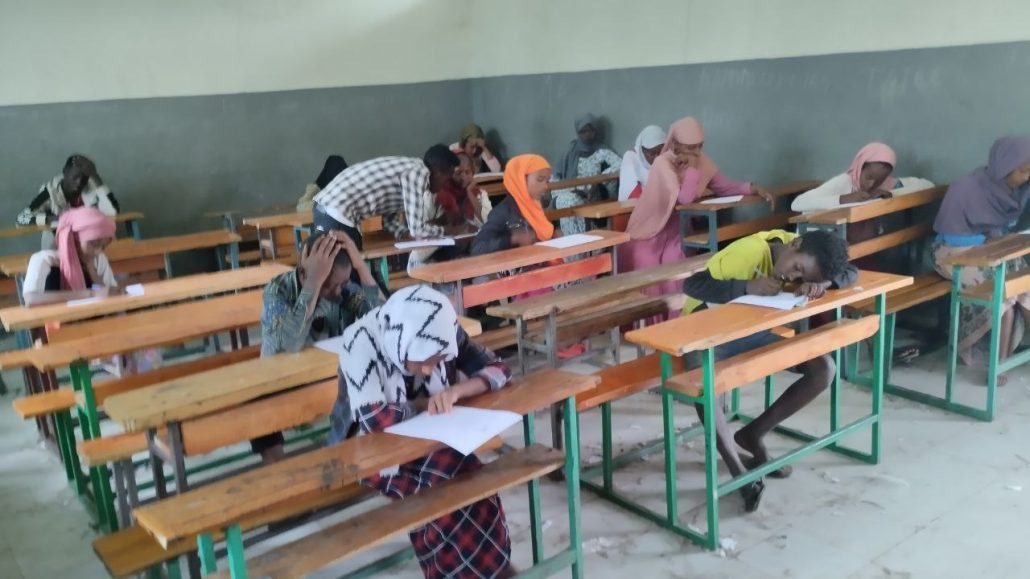
Let’s join hands and hearts to make a lasting impact, because together, we can change lives and create hope for those who need it most
is a social leadership skill training program that promote intercultural dialogue and community-led social development.

Youth-led Peace Dialogue Initiative - Learning to Live Together
Connecting Ethiopian Women and Youth Entrepreneurs to the Export Market: A Case of AfCFTA” is a capacity building project . . . . .
Today, it is quite common to find news related to school violence. Unfortunately, most of the people just listen and prefer to ignore such news. They even don’t want to know how this problem is getting bad to worse day by day. But ignorance is not a solution for any problem. YCDF together and IA developed a tool called School Violence Index (SVI) designed to reduce causes responsible for school violence.
The SVI was developed in 2017 in collaboration with the IA. It enables partners to ‘measure’ (assess) and discuss the level of violence, with a focus on capacities, progress, performance and joint learning, with the goal to:
YCDF took the initiative in adapting the SVI, in collaboration with IA, through an intensive process of meetings, discussions and information. In 2017, the SVI was used by 25 secondary schools in Addis Ababa, SNNP, and Oromia of Ethiopia targeted by the YCDF’s EIGSTA Project.
It is on the basis of this feedback and lessons learned that the SVI was refined, mostly to simplify principles and indicators that were subject to misunderstandings or broad interpretation. Detailed guidance on facilitating the SVI and the process of defining recommendations (plan of action) following the outcomes of the SVI have been included. A further round of development and testing of the tool is taking place in 2019.